Langley Launches New Research-Based Teacher Feedback Model

By Phil Petru, Assistant Head of School, The Langley School

The Langley School teachers have long been recognized as one of the best and most respected faculties in the Northern Virginia region. Research suggests that the single most important factor in student achievement is the quality of a student’s teacher. Thus, the recruiting and hiring process is taken very seriously when any opening occurs at Langley.

But just as important as hiring is the school’s commitment to develop teachers’ instructional and curricular knowledge and abilities. Langley invests heavily in the continuing professional development of our teachers as faculty attend national and regional conferences about the best practices surrounding their respective fields. While professional development is an important cornerstone of maintaining and growing a strong faculty, so is the evaluation model that a school uses to provide meaningful feedback about teaching and learning.

Starting this school year, The Langley School faculty are engaging in a new teacher evaluation system designed to provide more timely and meaningful feedback to teachers about their instructional practices in the classroom. After spending the last school year examining the previous system and exploring other models for teacher evaluation, the Langley Academic Leadership Team (ALT) instituted a new system, the Marshall Observation Method, which is based on the work and research of Kim Marshall. Mr. Marshall, a lifelong educator who resides in the Boston area, is nationally renowned for his work in teacher evaluation and feedback. Langley’s ALT worked with about 25 faculty members during the 2015-2016 school year who volunteered to pilot two potential models of evaluation and feedback before the final decision was made to implement the Marshall Method.

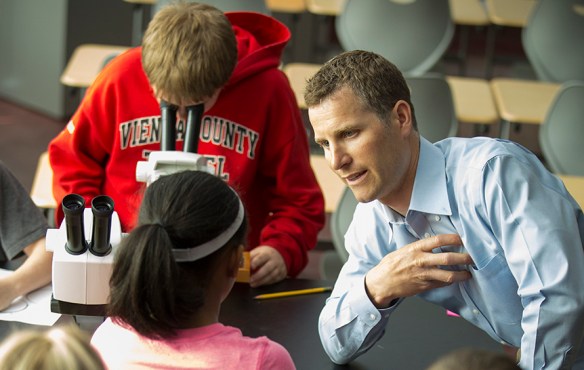
Under the new Marshall evaluation system, members of Langley’s ALT visit each faculty member at least eight times throughout the school year for short, focused observations. Following each classroom visit, the teacher and ALT member reflect on the areas of strength and growth of the lesson. The ALT member writes a summary of the post-observation conference, along with any recommendations, and sends it to the teacher for his/her review. Each teacher also meets with his or her supervising ALT member in January and May for a mid- and final-year conference to discuss professional growth. Research shows that more meaningful and frequent feedback about instruction results in more observable growth of teachers.
The Langley School

Feedback from Langley’s faculty is very positive. Ryan McKinney, Lower and Middle School science teacher and Science Department head, remarked, “As teachers, we know that teachable moments lead to authentic learning experiences that help students grow. Implementing the Marshall Method at Langley provides more of an opportunity for teachers and administrators to experience and reflect on events that happen between students and teachers in the classroom. These ‘teachable moments’ are used to help start the collaborative process of developing strategies that improve teacher performance. In the end, it is a win for the administrator, teacher, and most importantly, the students.”

Devon Davidson, grade 5 teacher, was also impressed with the new process for teacher evaluation as she stated, “I think the Marshall observations allow for more holistic and realistic observations. The regularity of having someone come into my room, and not just once a year at the end of the year, gave the observer and me the chance to examine my teaching and the students in a realistic manner. The observers see authentic moments in our room which help develop relevant and applicable feedback. I appreciate that the post-observation meetings are short, and are more of a conversation rather than an assessment of my performance. One of the things I find most helpful in our post-observation conversations are the immediately applicable suggestions. Throughout the year, we get into our routines and sometimes forget about ideas or strategies that could be effective for our students. The post-observation conversations I have had always spark an idea to refresh what I do in the classroom.”

We are very proud of the impact that this model is having on our already vibrant teacher culture and community, and most importantly, our students’ learning. We hope you’ll reach out to learn more about our program.


Learn about Langley


Why World Languages Learning Is So Essential to 21st Century Education

By Glenda De Hoyos, Spanish Teacher

We are educating students to develop skills that can help them work in future professions that might not even exist right now. The world is rapidly changing and the needs of a globalized society are difficult to predict with certainty. However, with total conviction we know that our students will need some important skills in the future.

To start the list: thinking creatively to solve problems, being flexible and adapting to changes, collaborating and communicating effectively with others, and having technology proficiency. Further, empathy, compassion, and open-mindedness are important capabilities that can be developed and that grow through academic and social experiences. Other skills that are also important to add to that list include the ability to be resilient and recover quickly and positively from the many challenges that are faced every day.

The Langley School - World Language

At The Langley School, we have a comprehensive curriculum that integrates the many areas that will lead students to develop those skills and many others. I’m so proud to be working in a school that understands the importance of learning a world language from a very young age, and how learning languages is a key element in the development of all the previously mentioned skills, among some others. Our students are given the opportunity through our World Languages Department to learn Spanish from Primary School, and later on, given the choice to learn French or Chinese. This program gives our students an incredible chance to be bilingual and, in many cases, multilingual. This solid foundation can be continued in their future studies in high school and college, opening doors to studies abroad and exchange programs and boosting their careers no matter the area.

As Dr. Scully mentioned in her recent “State of the School” address, the World Languages Department has spent the past academic year reflecting, researching, and planning ways to strengthen our program for our students. For the latter part of this year and into next, the department has begun redesigning its curriculum to be more meaningful and relevant to student learning through the use of a variety of new resources. In addition, the department has aligned new courses to the American Council on the Teaching of Foreign Languages’ (ACTFL) “Can-Do” statements, which help define higher proficiency levels for our students. And our program encourages teachers to speak in the target language for approximately 90 percent of the class time.

The ACTFL provides research studies that support the benefits of language learning in three major areas: academic achievement, cognitive development and abilities, and a positive effect in the attitudes and beliefs about language learning and about other cultures.

Research proves that language learning correlates with higher academic achievements, positive impact on reading abilities, increments in linguistic awareness, and higher scores on standardized tests like the SAT and the ACT, among many others. There is also evidence that cognitive skills, like memory, attention, motor, verbal, and spatial abilities, are impacted positively by learning more than one language. The global awareness provided by the cultural integration of the world language curriculum provides the space to develop empathy and a positive attitude toward others. Interesting articles and research publications that support these statements can be found on the ACTFL website.

Without any doubt, learning foreign languages and discovering the similarities and differences among other cultures has countless benefits in the academic and social-emotional development of all our students. When you combine the strong academic foundation in language arts, STEAM, fine arts, and world languages with a carefully organized social-emotional base, you have the opportunity to enhance and multiply the learning foundation of our students. That is what our students live at The Langley School. I feel very proud to have joined this outstanding learning community as well as to be part of a highly qualified group of world language teachers.
Learn about Langley

A Balanced Summer: Combining Fun & Learning Into One

By Ayesha Flaherty, Director of Enrollment Management

You’ve likely read about the “summer slide” – the research that says academic skills can decline significantly during the summer months when children are out of school. And, at the same time, we’ve all read about the importance of play and fun in creating curious, happy, and connected children.

If you’re like me, fully aware of the importance of both sides of this coin, how exactly do you strike the right balance? And, if our reality includes kids with full schedules, is there a way to give our children the gift of more free time without sacrificing advancement, progression, and learning?

As an administrator of The Langley School, I’m lucky to witness how our teachers find this balance every day. Langley teachers successfully and intentionally intertwine learning and structure with fun and independence. Students are joyful, challenging their thinking and expressing their choice all at the same time. For example, students are dancing, while also learning about musical composers. They are designing jewelry on a 3-D printer to raise funds for students in Kenya. They are enjoying an outdoor scavenger hunt adventure while solving math problems.

How can we recreate this at home? Join The Langley School for a 30-minute webinar on Thursday, May 19 from 12:00-12:30 p.m. titled “A Balanced Summer: Combining Fun & Learning Into One.” Participants will learn how to strike a healthy balance between continued educational enrichment and well-deserved summer fun.

Langley Webinar May 19

Register Now

A Peek into Inquiry-Based Learning at Langley

by Phil Petru, Director of Teaching & Learning

During a recent professional development day, our faculty and staff spent the day focused on inquiry-based learning featuring nationally renowned inquiry-based learning expert Diana Laufenberg, whose Ted Talk page has had more than 1.5 million views.

Screenshot 2016-04-12 21.20.18The day began with an opening talk from Diana, which focused on some of the key principles of inquiry-based learning. In particular, the opening session addressed the big ideas of process, student voice and choice, and answering questions with questions. Following Diana’s opening remarks, faculty divided into three groups and attended additional sessions, which provided them with strategies to apply inquiry-based concepts. The sessions were as follows:

LEARNING VISUALLY: Visuals work in the classroom because they grab students and allow an entry point to learning – and because they sum up pages and pages of information that would take a reader hours to process. Interactive infographics make kids want to immediately start clicking around to see what’s what. For a teacher who seeks to create an inquiry-driven classroom, that’s a great starting point. Diana provided a wealth of examples and practical applications for the use of visuals and infographics in the classroom.

INQUIRY – ASKING THE IMPORTANT QUESTIONS: Student participation in their education starts with instilling a sense of wonder and curiosity for their own learning which does not come easily. Privileging the student voice in the process of their own learning is critical. In this session, faculty discussed the power of this approach with students of all ages.

EVIDENCING LEARNING (STUDENT VOICE AND CHOICE): Checking for understanding, formative, summative, evaluating, grading…all are tools in the assessment toolbox. The commonality
is affording students a variety of ways to demonstrate or evidence their learning and receive meaningful feedback. Incorporating student voice and choice in the process is critical. Faculty delved into a discussion of assessment from the stand- point of the student, asking the question, “How will I increase the voice and choice of students to evidence their learning?”

The day concluded with division meetings, where the faculty had an opportunity to reflect and discuss their learning for the day. Conversations about inquiry-based learning will continue during grade-level, department, and division meetings for the remainder of the year.

Learn about Langley

The Colors of Me and My Friendships

by Paige Dunn, Art Teacher at The Langley School

As anyone with a Langley Primary Schooler knows, our youngest students take part in a month-long spiral unit each winter which features a theme that’s integrated into every subject area, including art. This year’s theme – the literature of Leo Lionni – provided a great opportunity for me to help our kindergarten art students discover themselves and their friendships through color.

After reading Mr. Lionni’s book, “Little Blue and Little Yellow” – which illustrates the relationship between blue and yellow and how their friendship creates a new color, green – we explored color theory and how the colors of the color wheel are organized. Students were asked essential questions such as: Why do artists use the color wheel? Why is color important?

The Langley School

Each student was given one color, which represented him or her. The class explored and experimented with various brushstrokes as they filled their papers, creating their own identity. Next, students paired with a friend and mixed their two colors to create their own unique friendship color.

Through this process, students learned how color has a deeper meaning than just what it looks like on paper – how it can represent your character and your relationship with others. As we discussed how colors create certain moods and feelings when we see them in art, the students identified their own moods and feelings when creating their identity colors.

Our kindergarten artists also learned how to work respectfully with one another as they explored blending their colors to create their friendship colors. Students beautifully worked through challenges that arose during the process as well. For example, when two students created a brown tone when mixing their identity colors, they were surprised because it was not a color on the color wheel. Their surprise quickly transformed into pure joy, however, as they created what they soon realized was an original color symbolizing their original friendship!

Students truly enjoyed illuminating their friendships with their classmates by exploring color. At the end of each class, the group had the opportunity to reflect. Students shared their colors by identifying them on the color wheel. Some colors that were made were not on the color wheel which provided the opportunity to discuss the process of color mixing on a deeper level.

The colors of our kindergarten artists and their friendships will be on display as a fish mosaic, one of Mr. Lionni’s characters, during their Spiral Unit Celebration performance on Friday, February 19.

Learn about Langley

Preparing Our Students for Their Digital Futures

by Brad Lands, Director of Technology

“If we teach today’s students as we taught yesterday’s, we rob them of tomorrow.” -John Dewey

It’s not surprising that we currently live in a world that is highly unpredictable and constantly evolving. It’s not surprising that technology seems to be exponentially increasing and global issues seem to be getting more complicated. What is surprising, however, is the fact that we as educators have to prepare our students for a future in which they will become productive and contributing members in this world.

Our role

Gone are the days where educators stand and deliver information and have students memorize basic facts that they might need to use some day. Students can easily perform a quick Google search on a mobile device to find this information. In today’s world, our job is to help our students become creative, critical thinkers who can learn how to access and use the world’s information to help them solve complex problems.

Traditional models of education require students to solve problems for which we know the solutions. One example is providing students with multiple-choice assessments. Alternatively, we as educators need to engage students in curriculum via inquiry-based learning, where students are empowered to ask their own questions and tackle problems for which the solutions are unknown. More importantly, we need to allow our students to struggle with these learning tasks, encourage them to troubleshoot, and praise their efforts when they persevere.

Technology at Langley

How do we do this?

Below are just a few of the inquiry-based projects in which Langley students have taken part this year:

20time Project Elective: In this Middle School elective, students are empowered to choose what they want to learn about, and are strongly encouraged to select challenging topics that have a real purpose outside of the classroom. This course is modeled after Google’s 20% time. Embedded in Google’s corporate culture is the concept of allowing engineers to take on independent projects. This unofficial policy lets them invest 20 percent of their work time on self-led explorations to solve real problems. Throughout Langley’s course, our students simulate this workplace experience by using the power of technology to identify problems, ask meaningful questions, pitch project proposals, develop solutions, present their ideas, and iterate their solutions. In other words, this course is designed to encourage the kind of “moonshot” thinking required to create novel solutions to unsolved problems, thereby helping to prepare students for future-ready innovation.

STEAM Challenge: Earlier this month, Langley fourth-graders engaged in a week-long STEAM (science, technology, engineering, arts, and mathematics) workshop where they experimented with physical computing. They learned about electricity, circuits, and computer programming by creating their own interactive monster. Students were tasked with sewing a monster out of felt and using electronic components such as LED lights, mini-speakers, a circuit board, and conductive thread in order to program the monster to output light and sound. Moreover, students were able to make their monster unique by choosing different colors, sizes, shapes, and creative code patterns. As they problem-solved and worked together, students not only learned about computer programming, but also developed valuable life skills such as persistence, flexible thinking, and collaboration.

Hour of Code: In celebration of Computer Science Education week, Langley students from all three school divisions completed Hour of Code activities. For many of our Primary and Lower School students, this was their first exposure to computer programming and they really enjoyed it. These computer programming activities varied from basic directional coding, to block coding, to text-based coding in many different computer programming languages. Even though the activities were different for each school division, all students engaged in challenging, critical thinking in order to complete each activity. The best thing about these activities was that there were multiple ways to complete them. Students were able to be creative in their critical thinking in order to solve each of the challenges, demonstrating that there is more than one way to solve a problem.

STEAM Fair: Langley’s first STEAM Fair will be held on Saturday, February 6, 2016. This is a very exciting event for the Langley community because it not only raises awareness about the importance of STEAM education in our world today, but also highlights Langley’s effort and dedication to teach our students to become creative problem-solvers. This family event is open to all students in preschool through grade 8 and will showcase how students interact with STEAM education at Langley. The STEAM Fair will include a display area of student work, open Lego play, technology demonstrations, a STEAM Book Nook, and hands-on activities for families. This is the perfect opportunity for both parents and students to learn, play, think, and have fun while exploring STEAM education at Langley.

So what’s next?

If we want our students to become independent, lifelong learners, then we need to continue to implement these critical learning opportunities at Langley – opportunities that allow our students to be naturally curious and work together to solve complex problems, that allow them to use technology to access information and creatively communicate their understanding, and that value the process more than the product. If we can continue to provide our students with this type of innovative education, then we are on the right track to preparing them for their future in the digital age.

Schedule a Tour to Langley

‘Tis the Season… To be Inquiring

By Mary Worthington, Director of Admission

December is one of my favorite times of the year. Langley’s campus is covered in garlands, the students are bursting with joy, holiday cheer fills our halls and the admission season is well underway. My days are filled with meeting new families, introducing them to our community and guiding them in finding the right educational environment for their child.

In my 8th year in Admissions at Langley, I continue to relish each admission season. It is a true pleasure meeting families with a deep commitment to their children. Welcoming curious student visitors to our classrooms is a highlight for not only our office, but also our student hosts as they share their school.

Our students are truly Langley’s best ambassadors. I want to share these wise words from one of our 8th graders – Jackson Sands – who joined Langley in kindergarten. Enjoy Jackson’s reflection on his experience in the video below.


In addition to our traditional admission events, we held three webinars throughout the fall providing families with important research and trend-based information regarding Langley’s dynamic program.

  • Introduction to Langley
  • Why Invest in a Private School Education?
  • Starting Young: What the Research Says About Choosing the Right Learning Environment

Langley Webinars

The demand for these types of events is exciting and we look forward to hosting more.

Langley’s application deadline is around the corner! For families interested in exploring Langley, I encourage you to take advantage of some of the material in this blog. Please also know that my door is always open as you think about the right school for your child. I wish all of you a happy, healthy and relaxing holiday season.


Schedule a Tour to Langley


The Langley School: Curtain Calls Through the Decades…

By Elena Meschieri, Director of Web and Social Media

“It’s not just a Middle School play!” This is what I said to my friend last week when I told her about The Langley School’s latest drama production, “It’s All Greek to Me.” This play is the most recent installment in a long-standing tradition of high-quality performances here at The Langley School.

Every year, the young cast surprises the audience with their talent and dedication to the art. The Middle School play is the perfect example of collaboration, dedication, and unending creativity. More than 50 students work together, each of them playing an important role, to ensure that the props, costumes, makeup, music, and lighting are all perfectly coordinated. The cast then dedicates countless hours memorizing each line to perfection and practicing their roles so the audience can not only enjoy the play, but feel like they are a part of the story.

I invite you to take a trip down memory lane and enjoy some of The Langley School’s past Middle School productions. View the video:


Follow us on Twitter to learn more about the next Middle School musical comedy!


The Hidden Power of Sixth-Grade STEM Week

By Kathleen Smith, Assistant Head of School

Thomas Edison famously said of creating the light bulb: “I have not failed. I’ve just found 10,000 ways that won’t work.” Experts in the field of education are currently researching and writing furiously about the “gift of failure” and the power it has to unlock creativity and innovation in our students. In his 2012 Harvard Business Review article entitled “The No. 1 Enemy of Creativity: Fear of Failure,” Peter Sims reminds us that “the odds are you were never, at any point in your educational or professional career, given permission to fail,” which puts us at risk of “disempowering yourself from exercising your inherent creativity.”

STEM WeekWe all agree that allowing for failure and growth and creating opportunities for students to be creative and innovative is essential to the development of their intellectual and moral character, of course. Now comes the hard part, if you’re a parent or an educator. At a primal level, we don’t really want our students to fail. Failure, despite all of its current good press, is often very painful. So how do we reconcile what’s in our heads and what’s in our hearts when we are dealing with young children and adolescents?

STEM WeekFirst, we reframe our definition of “failure” and internalize the idea that failure does not have to be a catastrophic endeavor. Second, we scaffold these opportunities so that students develop resilience over time and do not fall apart the moment they encounter a challenge. The sixth-graders’ recent STEM-immersion experience – a week during which they were encouraged to embrace failure and try, try again as they explored the world of bioplastics and polymers – provided exactly such an opportunity. The week-long chemical engineering workshop, developed by i2 Learning and researchers at Boston’s Museum of Science, challenged students to investigate, imagine, plan, create, test, improve, and communicate as they created bouncy balls, silly putty, and their own bioplastics. Reading the students’ reflections on their experiences was fascinating; they wrote not with frustration, but with joy about their failures and their perseverance when conducting attempt after attempt.
One sixth-grader wrote: “My best memory of STEM week was probably when I made the
car out of bioplastic. My group worked together really well, and we accomplished our goal. On the first try, we thought that we had made our mold perfectly. When we tried to put the pencils in, it just broke in half and we had to try again. On the second try, we made the base thicker and we made the wheels a lot bigger. It seemed like it would work, but the wheels wouldn’t harden and when we put the pencils in, it broke in half again. On the third try, we couldn’t make new bioplastic, so we used half of the second base and cut it into a circle. We had two wheels, so we melted our shavings down to more bioplastic. One of my group members had brought skewers instead of pencils, so we stuck those in and put the wheels on. It rolled!”

What a shame it would have been for one of my colleagues or me to step in with “TheSTEM Week
Answer” to these children’s questions as they puzzled through their initial “failures.” Encouraging students to ask their own questions – guided by faculty who embraced the open-ended, inquiry-based approach of the week – was essential to developing their intellectual toughness and grit. Pulitzer Prize-winning historian David Hackett Fischer observed that questions “are the engines of intellect – cerebral machines that convert curiosity into controlled inquiry.” In keeping with our professional development focus on inquiry-based learning this year, faculty feedback about the program centered on the need to continue to provide opportunities for students to practice this “controlled inquiry” throughout their years at Langley, for them to formulate questions and tough it out with scaffolded teacher support. Such practice begins to impart to students that failure is not just okay, but necessary. The world will not end if something doesn’t go right the first time. When students push past that 10,000th try that “doesn’t work” and come up with their working light bulb, they will have achieved something personally and intellectually meaningful. And all of the failures will have been worth it.

We are thrilled to be offering another intensive STEM week this year! Our fourth-graders will investigate the world of programming during their workshop, “Building a Friendly, Interactive Monster,” coming in January!

Schedule a Tour to Langley


First Impressions from Our Argentinean Friends

by Langley’s World Language Department

Each year, Langley hosts a group of middle school boys from the Rosario Jockey Club of Argentina with the goal of assisting our students in forming meaningful connections with native Spanish speakers. The exchange of ideas, language, culture, and sport with peers from across the globe prepares our children for an active role as global citizens.Langley and Jockey Club Rosario-Argentina

Additionally, each year, we enjoy exchanging unique experiences and reflecting upon our impressions of each others’ cultures. Here are a few of the highlights:

  • The Argentine boys were overjoyed to sit in the iconic yellow school busses they have seen in American movies and television.
  • Our eighth-graders learned that these Argentinean boys were enthusiastic about eating pizza, had mixed feelings about Lionel Messi (also from Rosario!), and were shy to express their love of Taylor Swift’s latest hits (who knew?)!
  • The Argentineans were eager to know why there were no locks on Langley’s student lockers. We were proud to discuss Langley’s core values of respect, kindness, honesty, trustworthiness, and citizenship with them.
  • Argentines and Virginians alike were amazed to learn from science teacher Ryan McKinney, who was our guide through Great Falls Park, that the 15-mile stretch of the Potomac River Gorge we visited includes over 1,400 different plants and over 200 rare species.
  • Though Rosario is over 5,000 miles away from Langley, our children formed connections that will last a lifetime.

Jockey Club de Rosario’s coach, Jose Perez Bustamante, summed up their visit to Langley in these words: “We believe the visit to Langley is one of the best things we do in our journey. The boys are back happy and at our meeting on our last day in the USA, several highlighted the visit to the school and to Great Falls. We take this visit as FUNDAMENTAL!!! It is part of American culture, and is part of our “story” here in Argentina. Every time we visit Langley, you all show friendship and love for your institution. Students, administrators, and coaches are always proud of the institution and make us feel welcome. You all proudly wear the Langley jersey!! The affection with which you treat us, the lunch, the facilities tour, and your friendship is for all of us a great joy! We want this to continue for many more years…”

A special thank you goes to our very own Spanish teacher and director of web and social media, Señora Meschieri, who established this program.

Interested to learn more?